
Lithium-ion batteries are now part of everyday school life. They power phones, laptops, radios, e-bikes, tools and, increasingly, electric vehicles.
While battery failures are rare, when they do occur they can result in fires that develop quickly and can be difficult to control. Damaged batteries, lower-quality products and inappropriate charging can increase the risk. And this isn't simply a theoretical concern.
There have already been incidents involving lithium-ion batteries in school settings. In one recent case, a student's backpack caught fire in a classroom after a damaged portable charger overheated, resulting in an evacuation and a response from the fire service.
Read the report from CBC News
The wider picture is also worth considering. UK data shows that fires involving e-bikes, e-scooters and their batteries have reached record levels, with hundreds of incidents recorded in a single year. For schools, the question isn't whether lithium-ion batteries are being used on site. They almost certainly are. The important question is whether the risks associated with them are understood and appropriately managed.
Think About Risk in Four Areas
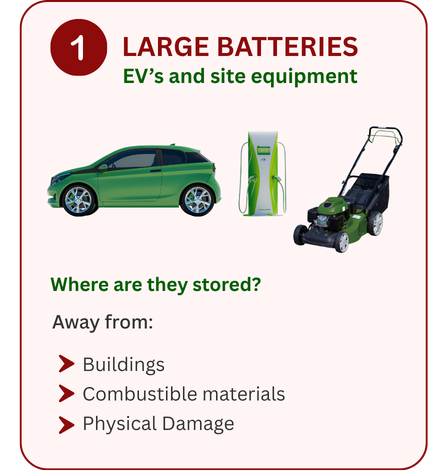
1. Large batteries: EVs and site equipment
As schools introduce electric vehicles and battery-powered grounds equipment, charging arrangements need to be considered as part of the wider fire risk assessment.
Consider:
- Are charging points located away from buildings and combustible materials, such as bins or sheds?
- Is there adequate separation or physical protection in place?
Where larger batteries are being charged or stored, understanding their location and the surrounding risks is particularly important.
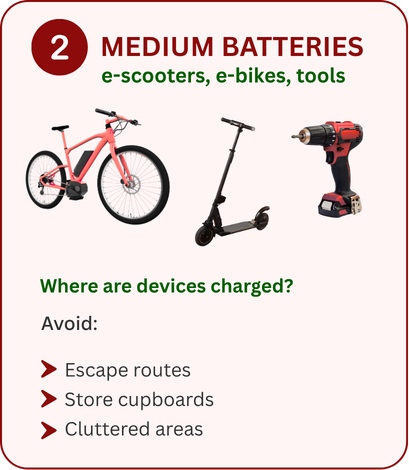
2. Medium batteries: e-bikes, e-scooters and tools
Medium-sized lithium-ion batteries can be found in e-bikes, e-scooters and larger cordless tools.
Schools should consider where these devices are being stored and charged.
- Are batteries being kept in stairwells, stock rooms, store cupboards containing combustible materials or escape routes?
- Are they being charged overnight or left unattended?
At the very least, schools should know what battery-powered devices are present on site and consider whether any require a separate risk assessment.
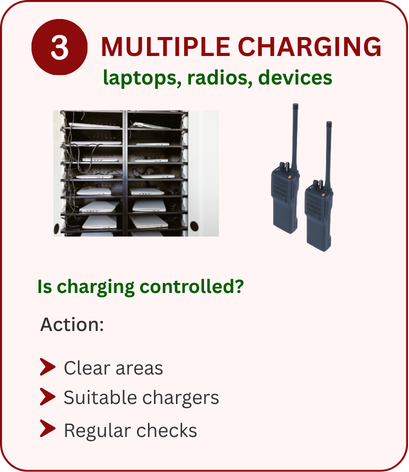
3. Multiple charging: laptops, radios and other devices
A single small battery may present a relatively low risk, but the picture changes when multiple devices are being charged together.
Schools may have laptop trolleys, walkie-talkies or central charging hubs containing numerous devices in one location.
Good practice includes:
- Keeping charging equipment away from escape routes.
- Avoiding overnight or unsupervised charging.
- Considering protected or fire-resistant metal cabinets where appropriate.
It is worth looking at where these charging points are located and whether the current arrangements remain suitable as the number of devices increases.
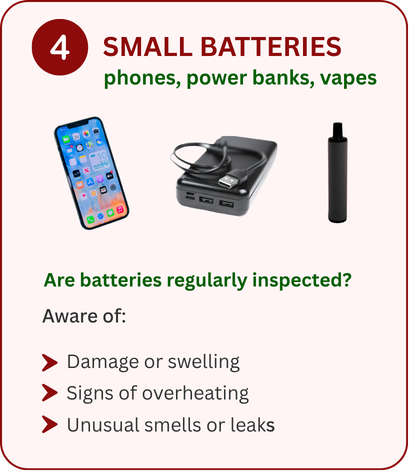
4. Small batteries: phones, power banks and vapes
Small battery-powered devices are widespread. Even where schools have restrictions on mobile phones, students may still bring other devices onto site, including power banks and vapes.
A clear and proportionate approach is to:
- Explicitly prohibit power banks on site.
- Align this with existing restrictions on phones and vapes.
- Recognise that there is no clear educational need for these devices in school.
The classroom incident mentioned earlier demonstrates why this matters. Although power banks are small, they can be damaged relatively easily and may be left charging inside bags or without supervision.
What About Staff and Personal Devices?
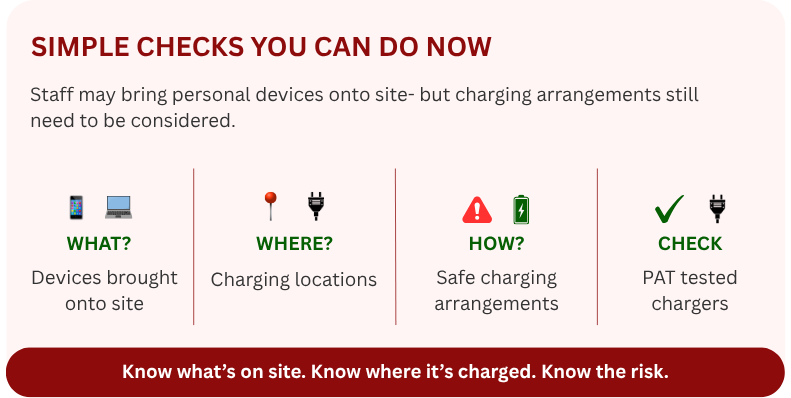
Schools will naturally want to support staff by allowing them to bring personal devices into work and charge them when needed. In most cases, this is reasonable, but it does introduce additional risks that need to be understood and managed.
The same considerations apply to personal devices as to school-owned equipment. Charging may take place in unsuitable locations, devices may be left unattended and, in some cases, higher-risk items such as e-bikes or e-scooters may be brought onto site.
These devices can pose a greater risk if they are damaged, modified or charged incorrectly, particularly where cheaper or less well-regulated models are involved.
Schools should therefore have a clear understanding of what is being brought onto site, paying particular attention to larger lithium-ion batteries such as those used in e-bikes and e-scooters, particularly where they are being charged.
Simple controls can help manage this without being unnecessarily restrictive:
- Be clear about where personal devices can be charged.
- Avoid charging in escape routes or unattended locations.
- Consider whether certain higher-risk devices should be excluded or restricted.
At a minimum, any chargers brought in from home should be PAT tested. This is a low-cost step that provides reassurance that electrical equipment is safe to use.
Schools don’t necessarily need to undertake a major review to start improving their approach. A few straightforward checks can help identify where attention may be needed.
Walk the site
Take a look at where devices are being stored and charged. Check whether devices are being left charging overnight, whether chargers are being used in cupboards, corridors or stairwells, and whether charging areas are clear of escape routes.
Take stock
Establish what battery-powered devices are actually on site, where they are stored and charged, and when they were last checked.
Review
Consider whether larger batteries are being stored and charged appropriately, whether escape routes are being kept clear, and whether current charging arrangements remain suitable.
Update
Make sure your fire risk assessment considers lithium-ion batteries, and that policies covering personal devices and charging reflect the risks on your site.
A Sensible Approach to a Growing Risk
Lithium-ion batteries are only going to become more common in schools.
This isn’t about avoiding technology. It’s about understanding where the risks lie and managing them sensibly.
A few simple checks, clear expectations and proportionate controls can make a real difference to safety.