

A Practical Guide to Effective School Timetables
The school timetable is one of the most powerful strategic tools available to secondary school leaders. It shapes curriculum delivery, staff workload, pupil experience, and the operational efficiency of a school. Yet decisions about timetables are often driven by habit rather than intent.
One of the most significant choices when designing or reviewing a school timetable is whether to operate a one-week timetable or a two-week timetable. Both models are widely used across UK secondary schools, and both can be effective when aligned to the right context.
Through our work supporting schools and trusts with timetable design and review, we regularly see the strengths and challenges of both approaches. This article explores the advantages and disadvantages of one-week and two-week timetables, helping leaders make informed decisions about their timetable structure.
Understanding One-Week and Two-Week School Timetables
Before exploring the advantages and disadvantages, it is important to define the two models clearly.
A one-week timetable repeats the same pattern of lessons every week. Each Monday, Tuesday and so on follows an identical structure.
A two-week timetable operates across a fortnightly cycle, often referred to as Week A and Week B, effectively doubling the number of available teaching slots.
Both approaches are common within UK secondary school timetables, particularly at Key Stages 3 and 4.
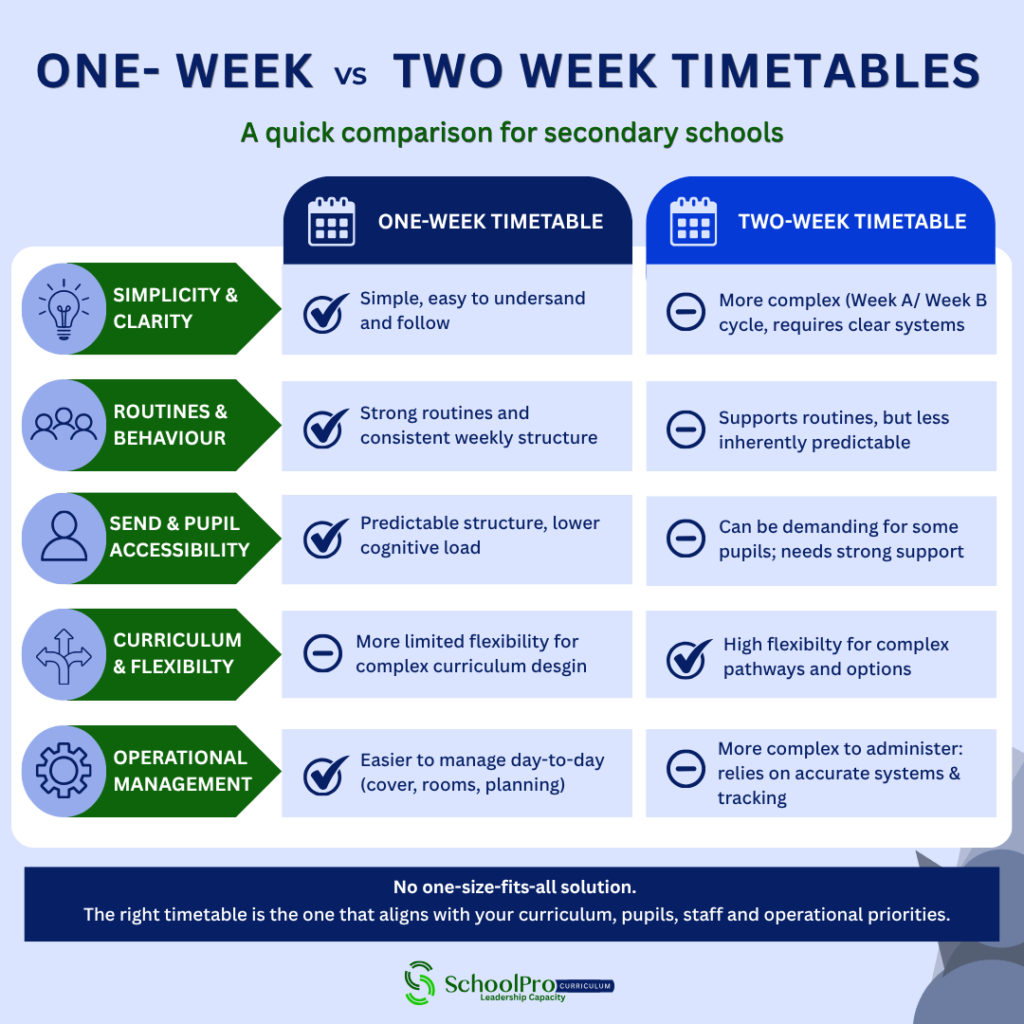
The One-Week Timetable in Secondary Schools
Advantages of a One-Week School Timetable
- Simplicity and accessibility
One-week timetables are straightforward for pupils, staff and parents to understand. The consistent pattern supports:
- Clear routines
- Reduced confusion
- Greater independence for pupils
This simplicity can be particularly valuable in schools with higher levels of SEND, where predictable timetables can help reduce anxiety and support inclusion.
- Strong routines and behaviour support
Consistency underpins effective behaviour systems. When pupils attend the same lessons on the same days each week, expectations become embedded. Many schools report improved punctuality and preparedness under a one-week timetable model.
- Lower cognitive load
Remembering a single timetable reduces organisational demands. This can be especially important for younger pupils and those who struggle with executive functioning.
- Easier day-to-day management
From cover arrangements to rooming and intervention planning, one-week timetables are generally easier to manage operationally, particularly in smaller schools or those without access to specialist timetable expertise.
Disadvantages of a One-Week Timetable
- Reduced flexibility in curriculum planning
A one-week timetable limits the number of available slots. This can make it harder to:
- Balance option blocks
- Accommodate vocational courses
- Distribute subject time evenly
- Gaps in learning
Subjects with low curriculum allocation may only appear once per week, leading to gaps that can affect retention and progress.
- Pressure on lesson length
Some schools compensate for limited slots by extending lesson duration, which may not suit all subjects or learners.
The Two-Week Timetable in Secondary Schools
Advantages of a Two-Week School Timetable
- Increased flexibility in school timetables
Two-week timetables provide significantly more freedom when designing secondary school timetables. They allow leaders to:
- Spread lessons more evenly
- Avoid long gaps between sessions
- Support complex KS4 and KS5 pathways
This flexibility is one of the main reasons schools seek specialist timetable support when moving to a two-week cycle.
- Improved staff workload balance
With more available slots, it is often easier to create equitable teaching loads across the fortnight. Two-week timetables can support:
- Part-time staff
- Shared teachers
- More balanced daily teaching commitments
- Better use of specialist spaces
Schools with high demand for specialist rooms often find that two-week timetables allow for more efficient use of resources.
Disadvantages of a Two-Week Timetable
- Increased complexity
Two-week timetables require greater organisational skill from pupils and staff. Common challenges include:
- Forgetting which week it is
- Missed lessons following absence
- Increased reliance on digital systems
- Impact on vulnerable learners
For some pupils, particularly those with SEND or anxiety, a two-week timetable can feel overwhelming without additional support structures.
- Greater reliance on systems and communication
Successful two-week timetables depend on strong pastoral systems, clear communication and, in many cases, specialist timetable support to ensure sustainability.
Choosing the Right Timetable for Your School
When reviewing or redesigning a timetable, leaders should consider:
- Curriculum intent and lesson frequency
- Pupil organisational skills and SEND profile
- Staff contracts and workload considerations
- Availability of specialist spaces
- Capacity to manage complexity internally or through external support
There is no universally “best” timetable. The most effective timetables are those that align curriculum ambition with the lived experience of pupils and staff.
School Timetables That Work Are Designed with Purpose
Whether a school chooses a one-week or two-week model, the quality of the timetable matters more than the length of the cycle. Poorly constructed timetables create daily friction. Well-designed timetables fade into the background and allow teaching and learning to flourish.
Increasingly, schools are recognising the value of specialist timetable support to ensure their timetables are not only compliant, but strategic, sustainable and aligned to their vision.
A timetable is never just a grid. It is a statement of priorities.
If you are reviewing your current timetable structure or planning for future curriculum changes, please do not hesitate to contact us. Our team works with schools and trusts across the UK to develop timetables that are practical, sustainable and aligned with their strategic priorities.