

This month-by-month guide is written by Mark Hodges, Director at SchoolPro Timetabling and Curriculum, with 25 years’ experience in Education, including Senior leadership roles. Mark has helped schools of all sizes create timetables that genuinely support teaching, learning, and strategic priorities.
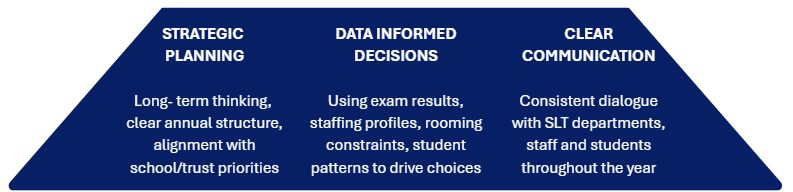
Over the past 10 years, I’ve helped schools of all sizes maximise curriculum efficiency and create timetables that genuinely support teaching, learning, and strategic priorities. While there’s no single formula for a perfect timetable, there is a strategic process I follow each year to ensure the timetable is intentional, manageable, and aligned with the schools’ needs.
A timetable shapes the rhythm and structure of a thriving school. With 25 years in education, including over 10 years in senior leadership roles as Deputy and Assistant Head Teacher, I know that every school has its own moving parts—pressures, priorities, staffing profiles, and student patterns. Adaptability is essential, and while I avoid hard and fast rules, I do stick to an annual schedule that guides the process from start to finish.
Below, I break down how I approach timetabling over the school year to make it strategic, structured, and stress-free. At SchoolPro Timetabling and Curriculum, we guide schools through this journey, translating this framework into a timetable tailored to your specific needs.
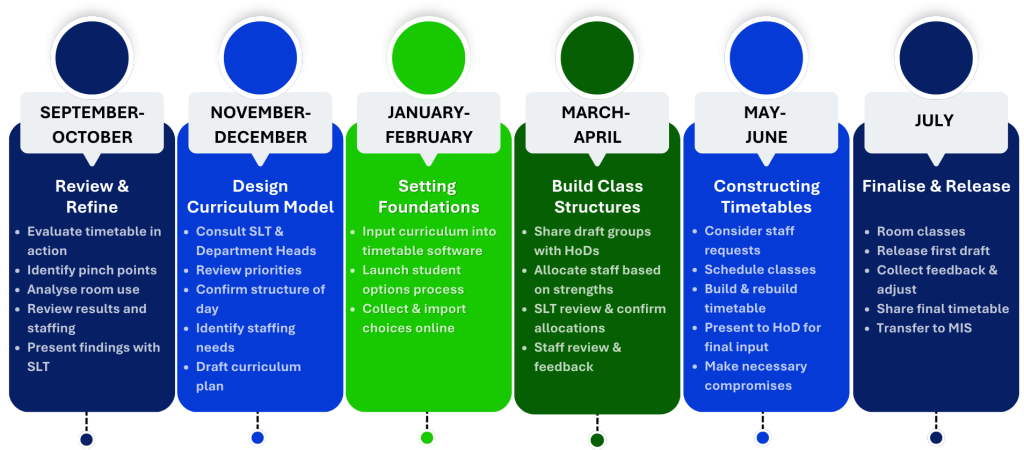
September to October: Review and Reflect
The new school year is the perfect time to see how the timetable is bedding in. I look for pinch points, evaluate room utilisation, and assess the student experience. Asking questions like, “Is there anything I could improve?” or “What should I build into next year’s timetable?” helps me refine the process annually.
Next, I review exam results and staff changes to see how they might impact the following year. For example, if a subject has underperformed, has declining numbers, or faces staffing challenges, it may require adjustment in weighting or support. These discussions happen in line management meetings with the Deputy Head and Head Teacher, and points are then taken to the Senior Leadership Team (SLT) for agreement.
November to December:
Consultation and Planning
At this stage, I consult with SLT and Heads of Department on the timetable model for the next academic year. Factors I consider include:
- Accountability measures
- School improvement priorities
- Student needs
I also confirm the structure of the school day—whether we need to change cycles, add periods, or adjust lesson lengths. For example, we might move from a one-week to a two-week timetable, add periods during the day, or adjust lesson lengths. Getting clarity now ensures the rest of the year’s work is built on solid foundations.
Once consultations are complete, I draft a curriculum plan in the timetable software. This highlights subjects that may require recruitment focus or staff allocation adjustments. The plan goes to SLT for agreement and forms the foundation for timetable construction.
January to February: Input and Options
By January, I have a clearer picture of the upcoming curriculum. I input staff, subjects, rooms, and levels into the timetable software.
I also start the options process, particularly for Year 9 students moving into Year 10 for GCSEs and Year 12 enrolments. Wherever I can, I shift this process online. This gives students easy access to the information they need to make informed choices and allows me to build the groupings efficiently within the system. Most MIS providers and timetabler software allow direct management of options, enabling easy import and reducing time spent on spreadsheets.
March to April: Modelling the Timetable
I now move into active timetable modelling. I share the draft class structures with Heads of Department so they can sense-check them and fill in any missing details. I then start allocating staff to classes, placing people where they’ll have the strongest impact.
As a member of SLT, I have a clear understanding of performance, strengths, and where the timetable can drive improvement. Using this insight, I work with SLT to finalise allocations before sharing drafts with teachers, who can either express their agreement or request adjustments.
May to June: Scheduling and Refinement
This is when the majority of scheduling work happens. Staffing requests are incorporated where possible, and classes are scheduled.
This stage usually takes several attempts, with multiple builds and rebuilds. I carefully analyse each version against all considerations from earlier in the process until I reach a point where I can share a workable timetable with the Heads of Department. There are always a few compromises along the way—after all, perfect is the enemy of good!
July: Finalisation and Release
Once I’m happy with the timetable, I assign rooms and share the first draft with staff. I review their feedback and make sensible tweaks—nothing major at this stage—before releasing the second draft. My goal is always for staff to have their final timetable at least two weeks before the end of the summer term, giving everyone a smooth transition into the new year, although occasional unforeseen pressures may cause slight changes.
This point feels like the culmination of the whole year. All the reflection, checking, consultation, and modelling come together to create a timetable that feels intentional, stable, and ready to be lived in. Once I’m confident everything is in place, I transfer it into the MIS, so come September, the school is ready to hit the ground running.

Supporting Your School Year-Round
Timetabling is a year-round task, not just a summer exercise. It requires careful planning, strategic thinking, and clear communication at every stage.
At SchoolPro Timetabling and Curriculum, we bring a wealth of expertise to support schools in a variety of ways—from full timetable construction to mentoring and training—making the process smoother, clearer, and far less overwhelming.
Need expert support with your school’s timetable?
Contact us at mhodges@schoolpro.uk for a free consultation.

Mark Hodges – Director, SchoolPro Timetabling and Curriculum
Mark is an experienced education professional with a strong background in senior leadership, training, and consultancy. He has worked with schools nationally and internationally to support curriculum development, timetable design, and productivity through technology. Mark holds a Masters in Education and is passionate about helping educators achieve their full potential.